

SIMON BOCCANEGRA
Giuseppe Verdi 1813-1901
Opera in one prologue and three acts
Libretto by Francesco Maria Piave,
Giuseppe Montanelli and Arrigo Boito,
based upon the eponymous drama
by Antonio García Gutiérrez
Premiere, 12 March 1857
Teatro La Fenice, Venice
Final version premiere
24 March 1881, Teatro alla Scala, Milano
Simon Boccanegra, or the Dark Side of Politics
This Verdian creation represents one of the deepest turning points in Giuseppe Verdi’s maturity, still fascinated by the dramas of the Spanish playwright Antonio García Gutiérrez. Inspired by him, Verdi found a robust framework of visceral conflicts, lost identities and sombre atmosphere that perfectly suited his evolving search for denser, less conventional dramatic realism; a more fluid musical continuity, far removed from closed forms and centred instead on interior monologue and dramatic declamation. García Gutiérrez’s play of the same name would be transformed, in the hands of Verdi and his collaborator Arrigo Boito, into a political manifesto, to which they would not hesitate to add entirely new scenes in their 1881 revision with the sole purpose of expressing in verse and music their own political ideal: the individual before the state and reconciliation within a new order of national unity.
Àlex Ollé sees Simon Boccanegra as a shattered mirror of the present: fractured societies, exhausted power and institutions incapable of reconciliation. His staging functions as a deliberate Tower of Babel, where costumes blend the 14h century with contemporary politics, suggesting that conflicts may change shape, yet the symbols of power endure. Sir Mark Elder conducts one of his favourite composers. He first approached Simon Boccanegra during his time at English National Opera and also recorded the 1857 version for the Opera Rara label. The Verdian baritone George Petean, a regular at Vienna, Covent Garden, La Scala and the Metropolitan Opera, has made Boccanegra his calling card thanks to his noble vocal line. Eleonora Buratto, who deeply impressed audiences with the three Donizetti queens, portrays Boccanegra’s lost daughter, while Francesco Meli plays her lover. Completing the cast is South Korean bass Jongmin Park as Fiesco, a singer with a solid voice and attractive dark timbre, trained in the La Scala environment under Mirella Freni and Renato Bruson, and with a broad career spanning Vienna, Bayreuth and the Metropolitan Opera.
Cor de la Generalitat Valenciana
Chorus master, Jordi Blanch Tordera
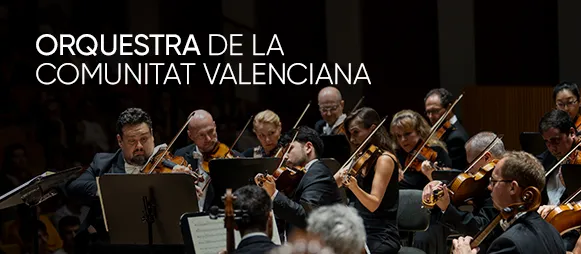
Orquestra de la Comunitat Valenciana
A new production from Palau de les Arts Reina Sofía, in co-production with Maggio Musicale Fiorentino
Calendar and sessions