


The Spanish National Ballet inaugurates the ‘Les Arts és Dansa’ cycle with ‘Invocation’
20.04.2022
Main Hall
- The program offers a global overview of Spanish dance with choreographies by Rubén Olmo, Antonio Najarro, and a tribute to Mario Maya.
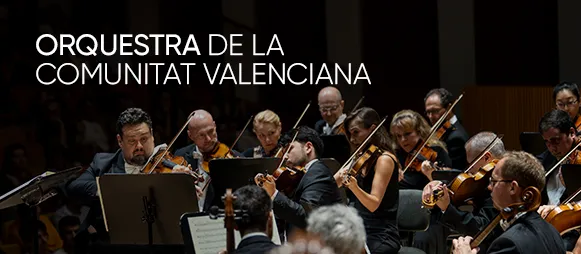
- Manuel Busto makes his debut as the conductor of the Orquestra de la Comunitat Valenciana, which will provide musical accompaniment for the four performances at Les Arts.
Valencia (20.4.22). The National Ballet of Spain (BNE) inaugurates the 'Les Arts és Dansa' cycle tomorrow, Thursday, April 21, with the show 'Invocación', which will be performed until the 24th in the Main Hall of the Palau de les Arts.
The company led by Rubén Olmo offers a global vision of almost all styles of Spanish dance with this quadruple program, premiered in 2020, which consists of choreographies by Rubén Olmo and Antonio Najarro, and also includes a tribute to Mario Maya, one of the pioneers of flamenco theatre in Andalusia.
Conductor and composer Manuel Busto makes his debut leading the Orquestra de la Comunitat Valenciana, which will provide musical accompaniment to the more than 40 dancers of the group in its four performances at Les Arts.
According to Rubén Olmo, director of the BNE: “It is a very complete program in which you can enjoy flamenco full of life and strength on stage, a 'ballet' of the purest stylized dance and one of the few recent choreographies of bolero school.”
The program opens with the bolero school choreography 'Invocación bolera'. This style is one of the most challenging disciplines in Spanish dance due to the speed of its steps and jumps, and the use of classical ballet steps alongside castanets. In this work, Rubén Olmo updates the essence of the traditional bolero school, while also paying homage to the great masters who shaped the style.
The music for 'Invocación bolera' is an original contemporary composition commissioned by the Spanish National Ballet from the young Sevillian composer and conductor Manuel Busto, who later also contributed to the collective score of 'La Bella Otero'. The costumes were designed by Pedro Moreno for the work 'Fandango del Padre Soler', premiered by the Spanish National Ballet in 1988, and have been adapted by the designer himself for this production.
The same creative duo of Rubén Olmo and Manuel Busto are responsible for 'Jauleña', a solo piece that intertwines various dance styles, with a special emphasis on zapateado and granaína. In Valencia, Miguel Ángel Corbacho, assistant director, and José Manuel Benítez, a solo dancer, will alternate on stage as performers.
'Eterna Iberia', by Antonio Najarro, completes the first part of the show. It is a stylized dance choreography, premiered by the BNE in 2019, which uses traditional elements of Spanish dance such as the cape and the Cordoban hat.
The music for this work was originally composed by Manuel Moreno Buendía for Antonio Ruiz Soler's ballet 'Eterna Castilla' and later published as a suite entitled 'Celtiberia'. Yaiza Pinillos' sophisticated costumes represent the richness of our region through the use of blue, green, and maroon to symbolize three of our treasures: the sea, olive groves, and wine.
Flamenco takes center stage in the second part of the 'Invocation' program with the inclusion, for the first time in the repertoire of the Spanish National Ballet, of a choreography by Mario Maya, a leading figure in Spanish dance renowned for his genius and sensitivity. Having passed away in 2008, he was a pioneer of flamenco theater, the creator of daring and innovative productions, and one of the most tireless researchers of our time.
Rubén Olmo has selected 'De lo flamenco' because, in his opinion, this production by Mario Maya, premiered by the Andalusian Dance Company in 1994, refreshed the way flamenco was performed and felt on stage through its stylization and movement, especially with a large company of dancers. "Even now it remains innovative and completely different from the rest," says Rubén Olmo.
The production of 'De lo flamenco' presented by the National Ballet of Spain differs from the original by Mario Maya, Milagros Menjíbar, A. Rueda 'Toná' and Manolo Marín in the two new choreographies signed by two regular collaborators of Mario Maya: 'Romance del emplazado', by Rafaela Carrasco, and 'Taranto', by Isabel Bayón.
This revival also features collaborations with artists who were part of the original cast, from the rehearsal director Manuel Betanzos to the musician Diego Carrasco, one of the songwriters, along with Jesús Torres, Moraíto Chico, and Los del Río. The costumes are replicas of the original designs by Mario Maya and have been hand-painted by Juan Andrés Amaya.
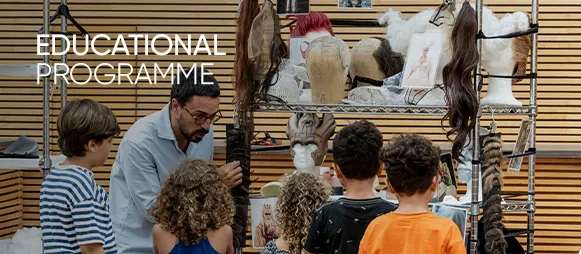
Coinciding with the performance of the National Ballet of Spain in Valencia, a group of 25 children from the SOS Children's Villages family strengthening and prevention program will attend the educational workshop in the Aula Magistral of the Palau de les Arts on April 20 and, later, the general rehearsal of the show.
In this activity, the principal dancer Sergio García, the rehearsal teacher Maribel Gallardo and the head of the Department of Pedagogical Activities, Belén Moreno, introduce children to Spanish dance through some of its most characteristic elements, such as the shawl, clapping, footwear and castanets.
The activity, which is included in 'Les Arts és Educació', is also supported by interactive teaching materials published by the BNE: an illustrated book, three booklets with augmented reality and a video game.
National Ballet of Spain
The National Ballet of Spain (BNE) is the leading public company for Spanish dance. Founded in 1978 as the Ballet Nacional Español, with Antonio Gades as its first director, it is part of the production units of the National Institute of Performing Arts and Music (INAEM), under the Ministry of Culture and Sport. The BNE's mission is to preserve, promote, and transmit Spain's rich choreographic heritage, encompassing its stylistic diversity and traditions, represented by its various forms: academic, stylized, folklore, bolero, and flamenco. It also works to reach new audiences and promote its national and international presence within a framework of complete artistic and creative autonomy.
Rubén Olmo
Rubén Olmo, winner of the 2015 National Dance Prize, joined the Spanish National Ballet in September 2019 with the aim of preserving, promoting, and expanding the traditional repertoire of Spanish dance, while also incorporating new creations and embracing avant-garde and experimental approaches. This marks his second stint with the BNE, a company he was a member of as a dancer between 1998 and 2002.
Since 2011, he has served as director of the Ballet Flamenco de Andalucía, an institution under the Andalusian Regional Government, with which he premiered his own productions such as 'Llanto por Ignacio Sánchez Mejías' and 'La muerte de un minotauro'. Previously, he formed his own company, for which he created shows such as 'Érase una vez', 'Belmonte', 'Las tentaciones de Poe', 'Horas contigo', 'Naturalmente Flamenco' and 'Diálogo de Navegante'.
He has also collaborated as a choreographer or dancer with prominent figures in Spanish dance such as Aída Gómez, Antonio Najarro, Eva Yerbabuena, Víctor Ullate, Antonio Canales, Rafael Amargo, Isabel Bayón, Rafaela Carrasco and Aída Gómez.

